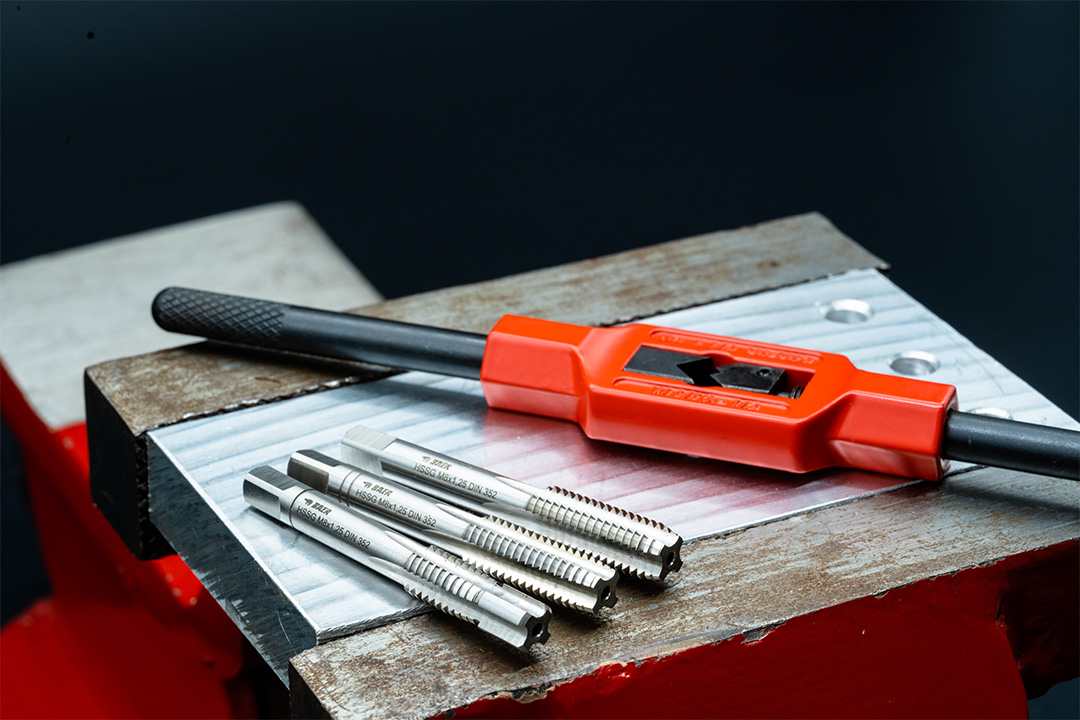
Tapping is a crucial process in machining and manufacturing that involves creating internal threads inside a drilled hole. These threads allow screws or bolts to be securely fastened into materials such as metal, plastic, or wood. Among the most commonly used tapping tools are machine taps and hand taps. While both serve the same primary purpose of thread cutting, they differ significantly in design, application, speed, and precision. Understanding the difference between machine tap vs hand tap helps professionals, hobbyists, and manufacturers choose the right tool for their specific threading needs.
What Is a Hand Tap?
A hand tap is a manually operated cutting tool used to create threads inside a hole. It is typically used with a tap wrench and requires physical rotation by hand to cut threads gradually. Hand taps are often sold in sets of three: taper tap, plug tap, and bottoming tap. Each type serves a different stage of the threading process.
The taper tap has a gradual cutting edge that makes it easier to start threading, while the plug tap continues the process with deeper cutting. The bottoming tap is designed to cut threads close to the bottom of a blind hole where full threading depth is required. This step-by-step approach gives the user greater control and reduces the risk of damage to the workpiece.
Hand taps are widely used in maintenance, repair work, and small-scale projects where precision and manual control are more important than speed.
What Is a Machine Tap?
A machine tap, as the name suggests, is specifically designed for use in machines such as drill presses, CNC machines, and tapping machines. Unlike hand taps, machine taps are built for continuous and efficient thread cutting with higher speed and consistency. They are manufactured with stronger materials and optimized flute designs that allow chips to evacuate more effectively during the threading process.
Machine taps can handle higher torque and are ideal for repetitive industrial applications. They are commonly used in manufacturing environments where large volumes of threaded holes are required with uniform accuracy. Machine taps often come in different styles such as spiral point taps, spiral flute taps, and form taps, each suited for specific materials and hole types.
Key Differences Between Machine Tap and Hand Tap
1. Method of Operation
The most noticeable difference is how they are used. Hand taps are operated manually using a tap wrench, which allows the user to feel resistance and adjust pressure accordingly. Machine taps, on the other hand, are used with powered equipment, making them faster and more efficient for bulk production.
Manual tapping requires patience and skill, while machine tapping focuses on speed and automation. This difference significantly impacts productivity and workflow in industrial settings.
2. Speed and Efficiency
Machine taps are far more efficient than hand taps when it comes to speed. They can produce threads quickly and consistently, making them ideal for mass production. Hand taps, however, are slower because the process involves gradual manual rotation and periodic backing off to clear chips.
For small jobs or occasional threading tasks, the slower speed of hand taps is not a disadvantage. But in large-scale manufacturing, machine taps are the preferred choice due to their time-saving capability.
3. Precision and Consistency
Machine taps offer higher consistency, especially when used with CNC machines or automated systems. They produce uniform threads across multiple workpieces with minimal variation. Hand taps depend heavily on the user’s skill and experience, which can sometimes lead to uneven threading or alignment issues.
However, hand taps provide better tactile feedback, allowing users to detect misalignment or material resistance early in the process.
4. Strength and Durability
Machine taps are typically made from high-speed steel (HSS) or carbide and are designed to withstand higher torque and continuous use. Their construction allows them to handle tougher materials and longer production runs without wearing out quickly.
Hand taps, although durable, are not intended for high-speed or heavy-duty operations. They may wear out faster if used frequently on hard materials.
5. Chip Removal and Design
Machine taps are engineered with advanced flute designs to manage chip evacuation efficiently. Spiral flute taps pull chips upward in blind holes, while spiral point taps push chips forward in through holes. This design reduces clogging and improves thread quality.
Hand taps require frequent reversing during use to break and remove chips manually, which adds to the time and effort needed.
6. Application and Usage
Hand taps are best suited for repair work, custom jobs, and small workshops where flexibility and control are required. They are also ideal for threading delicate materials or when power tools are not available.
Machine taps are widely used in industrial production, automotive manufacturing, aerospace components, and large fabrication projects where accuracy and speed are essential.
Advantages of Hand Taps
One of the biggest advantages of hand taps is control. Users can carefully monitor the threading process and adjust pressure as needed. This makes them ideal for beginners and precision work. They are also cost-effective and require minimal equipment, making them accessible for small businesses and DIY enthusiasts.
Additionally, hand taps are versatile and can be used in tight spaces or on-site repairs where machine setups are not practical.
Advantages of Machine Taps
Machine taps excel in productivity and efficiency. They reduce manual effort and ensure consistent thread quality across multiple holes. Their ability to handle high-speed operations makes them indispensable in modern manufacturing environments.
They also provide better thread accuracy, especially when used with automated machinery. This level of precision is crucial in industries where tight tolerances are required.
When to Choose Machine Tap vs Hand Tap
Choosing between a machine tap and a hand tap depends on several factors, including project size, material type, and available equipment. If you are working on a single project or performing maintenance tasks, a hand tap is often the better choice due to its flexibility and simplicity.
On the other hand, if your work involves repetitive threading, hard materials, or large production volumes, machine taps offer superior performance and efficiency. Workshops equipped with CNC machines or drill presses will benefit significantly from machine taps due to their speed and durability.
Cost Considerations
Hand taps are generally more affordable than machine taps and do not require expensive machinery. This makes them ideal for hobbyists and small-scale operations. Machine taps, while more expensive, provide long-term value in high-production environments by reducing labor time and increasing output.
Investing in the right type of tap based on workload can lead to better cost efficiency over time.
Conclusion
Machine taps and hand taps are both essential tools in the threading process, but they serve different purposes depending on the application. Hand taps offer greater control, affordability, and suitability for small-scale or precision tasks, while machine taps provide unmatched speed, durability, and consistency for industrial production. Understanding their differences in operation, efficiency, design, and application allows users to select the right tool for their needs.
Ultimately, the choice between machine tap and hand tap should be based on project requirements, production volume, and available equipment. By selecting the appropriate tapping tool, you can improve thread quality, reduce errors, and enhance overall machining efficiency.